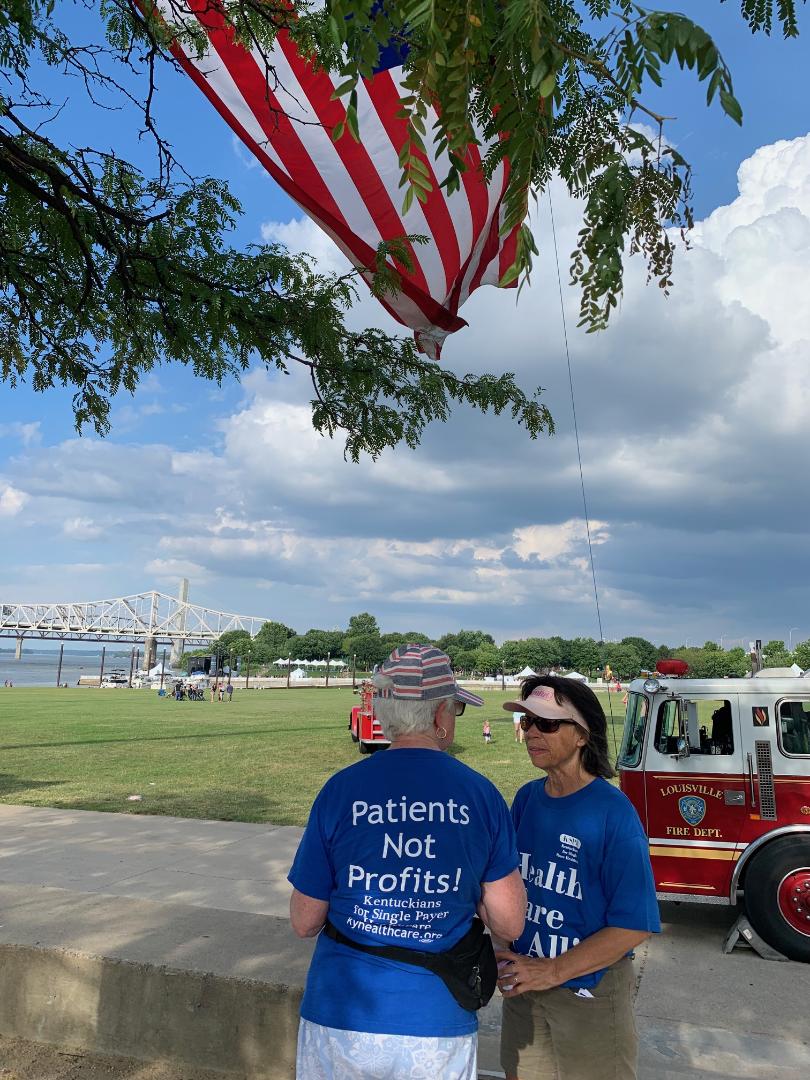
On July 4, 2019, single payer activists worked to spread the message to a crowd that gathered for a concert at Louisville’s Waterfront Park. Many voiced their
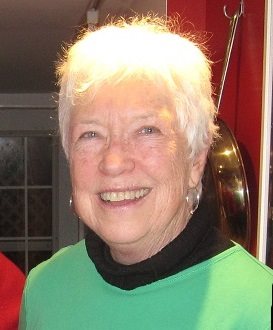
July 4 in Louisville, KY. L to R Harriette Seiler and Christine Perlin-Gump. Photo by Doris Bailey Spencer.
support and signed petitions for a National Improved Medicare for All.
The group distributed tiny “Forward to Single Payer” flyers and “Medicare for All” cards.
The discussions reflected the urgency of the problem. People spoke of the price of insulin, of sky high deductibles, and of friends and family who could not afford care.
Dr. Robert Crouch proposes “Stop Surprise Medical Bills” legislation to shield patients from bills for out-of-network health care. (“Surprise Medical Bills Must Stop” June 22, 2019)
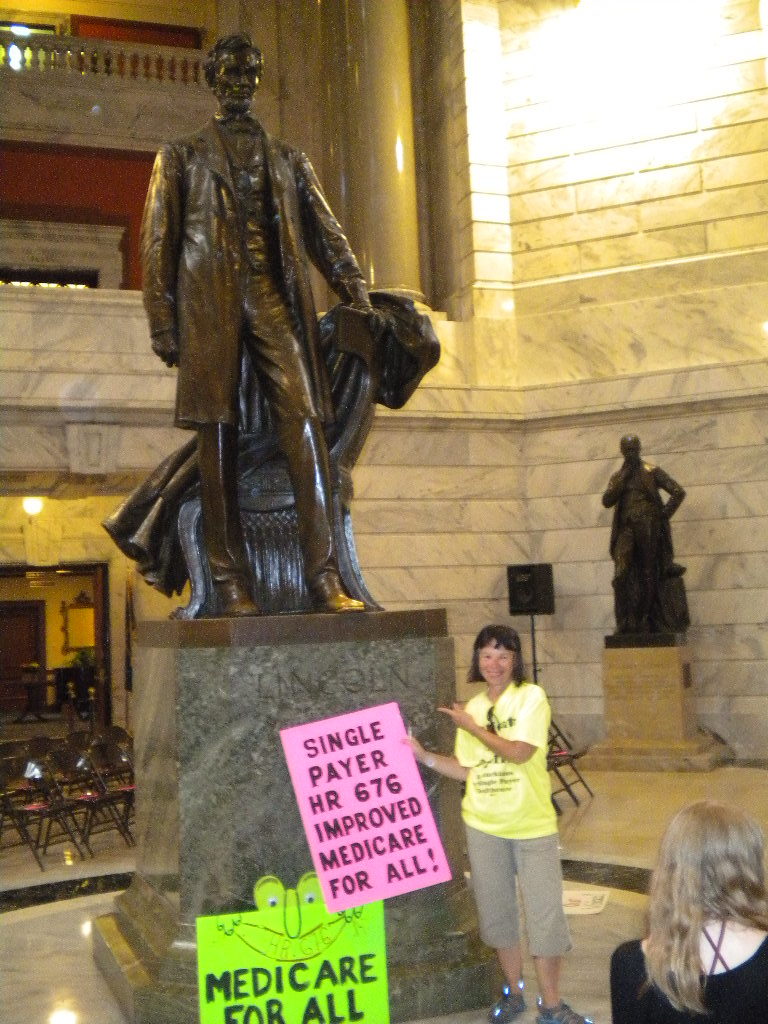
Christine Perlin-Gump at a rally for health care in the Capitol Building in Frankfort
We should recall that the concept of in- network and out-of-network is a creation of the for profit health insurance industry. I disagree with Dr. Crouch when he says he cannot control surprise billing of his patients. As an officer of the Kentucky Medical Association, he can take a look across the border to our
Canadian neighbors, find out about their health care system, and advocate that the United States adopt an improved medicare for all, which completely eliminates private health insurance companies from essential services. Every penny of our healthcare dollar should go to providers, not to corporate middlemen who have so successfully interposed themselves between physician and patient in this country.
Corporations exist to provide dividends to shareholders, with hundreds of intelligent employees coming up with new schemes, such as networks, to do just that. One is just playing whack-a-mole by coming up with a piece of legislation that may limit a particular type of corporate outrage.
Of course, a patient going through a health crisis is in no position to know the contractual arrangements between the person giving them an anesthetic, the insurance company and the hospital, and is probably too weak to complain when he spends the years of convalescence dealing with hospital bills, collection agencies and foreclosure. Less deserving of sympathy are the “hospitals and physicians (who) have become overwhelmed”, trying to keep up with the shifting requirements of health care corporations. Some pain, yes, but ‘let the free market sort this all out.
We have tried that, in an increasingly complex system that costs us twice as much as nations with national health programs, programs which cover everyone, and do not leave tens of millions un – or under insured as in this country. To advocate for his patients, Dr. Crouch should support improved Medicare for all.
Statement of Kentuckians for Single Payer Health Care to the Ways and Means Committee Hearing on Pathways to Universal Health Care
We thank Chairman Neal for scheduling this hearing, boldly calling on members of the Committee and those giving testimony to propose solutions to the problems of a health care system in crisis—a system that costs far too much yet leaves millions to suffer needlessly for lack of care.
Our organization has been working since 2004 to bring Kentuckians together to push for a national health program that will solve this crisis for our state and for the nation. We have worked since that time to educate ourselves, communities across the state, office holders, and candidates on sound health care policy that can bring high quality care to everyone.
With this testimony we share what we have learned, and we urge the Committee to act upon it to enact a national single payer health care system, an improved and expanded Medicare for All as spelled out in the plan of the Physicians’ for a National Health Program (PNHP).1
Marcia Angell, MD, former Editor of the New England Journal of Medicine, has pointed out that that we cannot simultaneously (a) increase care and (b) cut costs unless we change to a single payer system that removes the profits and the insurance companies.2 Under our current health care system, all efforts to rein in the costs result in cuts to care. Plans designed to cover more people and improve care end up dramatically increasing the costs.
That opposite movement of cost and care informs us that as long as the profits of the insurance companies and investor-owned facilities are involved in health care, we cannot improve and expand the care without costing us more than our already outrageously expensive annual health care bill.
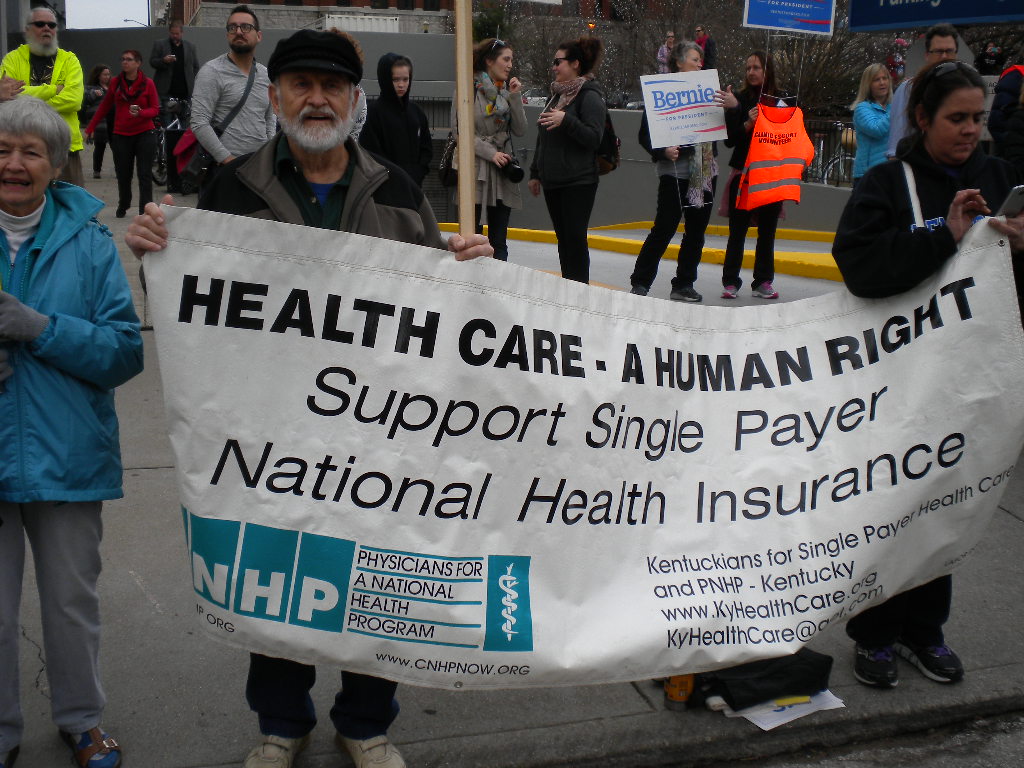
Banner of Kentuckians for Single Payer Health Care
On June 12, 2019, the House Ways and Means Committee held a hearing on Pathways to Universal Health Coverage. You can watch the video here.
Don Berwick, MD, MPP, former director of the Center for Medicare and Medcaid Services, was among the witnesses. He said “The United States ranks 56th in the world in infant mortality and 43rd in life expectancy.” You can read his testimony here.
Video. The orientation straightens out after a few minutes.
On Saturday, June 8, 2019, at Blue Cross and Blue Shield of Illinois Headquarters in Chicago, students, physicians, nurses, unions, and single payer activists from around the country protested against the American Medical Association’s opposition to Improved Medicare for All.
From the Blue Cross and Blue Shield Headquarters the demonstrators marched to the Hyatt Regency Chicago to call on the American Medical Association to stop actively campaigning against Medicare for All, which 55% of physicians and the vast majority of people in the US support. Inside the AMA meeting a number of protesters staged a die-in to dramatize the consequences of the AMA policy.
Demonstration at the AMA in Chicago
The AMA’s opposition to Medicare is longstanding.
In 1968, Dr. Sidney Wolfe, co-founder and director of Public Citizen’s Health Research Group, politely and briefly took over a microphone at the American Medical Association’s national meeting because of the A.M.A.’s opposition to the right to health care.
Fifty-one years later, the A.M.A., along with its well-financed corporate partners in the Partnership for America’s Health Care Future, is still leading the charge against universal, single-payer health care, also known as Medicare for All.
There is a brief video of Dr. Sidney Wolfe at this link.
Rep. John Yarmuth, Chair of the Budget Committee, held a public hearing on “Key Design Components and Considerations for Establishing a Single-Payer Health Care System.”
The hearing took place on Wed. May 22, 2019, at 10 AM in 210 Cannon House Office Bldg. in Washington, DC. The witnesses were from the Congressional Budget Office (CBO). Rep. Yarmuth has said that there will be another hearing in the Budget Committee on Medicare for All that will hear from other witnesses.
With a population approaching 772,000, Louisville/Jefferson County is roughly the same size as Winnipeg, Canada; Frankfurt, Germany; and Marseilles, France. Each of these cities has a budget covering operations, economic development, urban renewal, housing, etc., but only Louisville expects to pay over $50 million during the 2019-20 budget year to provide health insurance for city employees and retirees. Most of that sum will go to HUMANA, a private company that paid its CEO $16.3 million in compensation in 2018. This coming year, Metro workers facing stagnant wages can expect health plan premiums and deductibles to rise.
Harriette Seiler, Secretary, Kentuckians for Single Payer Health Care
Municipalities large and small across the U.S. are held hostage by the costs of health insurance. Why are we locked into this foolish and inequitable system? In other advanced nations, cities do not go broke, cut police services, close recreational facilities to pay for health care. Why? Because their national government has done the math and set up a single-payer plan to cover every resident. All taxpayers participate, sharing risk and cost; for-profit insurers are heavily regulated, or not allowed.
I call on the voters and elected leaders of our community (whatever your party affiliation) to study the cost-effectiveness of single payer. We may not be able to fix this year’s city budget, but surely future budgets will reflect the fiscal common sense of running a city within a single-payer system.
This letter appeared in the Courier-Journal on May 3, 2019.
Great thanks to Dr. Garrett Adams for spelling out the benefits of a single payer, Medicare for All nationalhealth plan. I remember going to a single payer rally in Jeffersonville when a Koch Brothers’ “Americans for Prosperity” bus pulled up. People organized by the Kochs emerged with their rehearsed talking points to protest single payer and overwhelmed our rally. Doesn’t that speak volumes about who benefits from the for-profit insurance and pharmaceutical industries?
Distributing fliers at Walk for MS, 05-30-2015
In those countries Dr. Adams cited, and several others, nobody goes bankrupt from medical bills or worries about losing health insurance if they lose or quit their job. Preventive care is more accessible, helping to avoid putting off treatment until it’s lifethreatening. Their generally healthier diets also contribute to their longer life expectancy and better overall health. The high calorie, high salt (sodium) and sugar in our grocery and restaurant foods are literally killing us. One in four U.S. deaths is diet-related. Read all labels carefully. Avoid processed foods and look for lower calorie, lower sodium choices in restaurants. Healthier diets and Medicare for All will put us on par with the rest of the developed world.
On Tuesday, April 30, 2019, House Rules Committee Chair Jim McGovern presided over an all day hearing on Medicare for All. You can see the video of the hearing here.
Reprinted from the Courier-Journal, April 16, 2019
Your turn, Garrett Adams, Guest columnist
American health care is in continuing crisis. Access is declining, and costs are out of control. Medical bankruptcies, unheard of in other developed countries, still plague us. Even though the U.S. spends nearly twice as much per capita on health care, our health outcomes are far worse than other comparable nations. For example, way more American women die of pregnancy-related complications, and the rate is rising.
Statistics are people with the tears wiped dry.
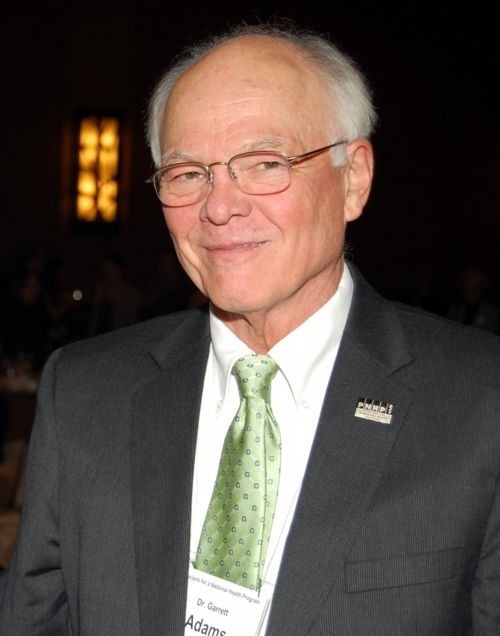
Garrett Adams, MD, MPH
What’s wrong? Corporate profiteering. Corporations squeeze the insured, you, for every nickel to pay their dividends and increase cash value. Insurance companies raise premiums, deductibles and copays; they deny claims and contrive to insure only healthy (cheap) people.
The patchwork of private insurance costs our nation billions in administration, billing and collecting – amounting to a full third of health care expenditures.
Hospitals track every pill and bandage and charge for each item. Physicians spend an average of nine hours a week with a jumble of plans for billing, preapproval and payment. It is taking a toll on the profession in burnout, early retirement, depression and suicide. Patients are angry and frustrated by the bureaucratic maze of filing claims, with justifiable claims often rejected.
Medicare Advantage, which privatizes Medicare, is burdened with fraud and poor cost control. Insurance companies selling Advantage plans bilked the government for an estimated $70 billion between 2008 and 2013.
The U.S. system isn’t about improving health care; it’s about profit. Single-payer changes the dynamic; with single-payer the system becomes patient-oriented, not profit-oriented.
Single-payer means ONE payer, the government, pays the bills while health care delivery (doctors and hospitals) remain in private hands. The wasteful bureaucracy of private health insurance goes away. The government becomes the insurer. Coverage is unhooked from employment, allowing workers to change jobs or start new businesses.
What about workers for insurance companies when single-payer replaces private insurance? The new system will need their administrative experience. Moreover, single-payer legislation specifies that displaced workers be provided retraining and two years of salary. Many, who are health care workers themselves, will move back to actually providing care. And, like all of us, they and their families will have all medically necessary care as a right!
In 2003 the first single-payer bill in the U.S. Congress was tagged the Medicare-for-All bill. The name stuck. Today there are many “Medicare for Alls.” However, only two are single-payer plans, one House and one Senate version. They provide for publicly financed, nonprofit national health insurance that fully covers medical care for all Americans.
Drug companies, for-profit hospitals, insurance companies and others invested in profit-based care are campaigning vigorously against single-payer, spreading misinformation and fearmongering.
Don’t believe the lies. National health plans work extraordinarily well in every other industrialized nation. Canada, Scotland, Sweden, Taiwan, Japan and dozens of others cover their entire population for a fraction of what the U.S. spends (wastes!) and enjoy longer lifespans and better health outcomes. An American single-payer plan will pay for itself by redirecting wasted administration and profiteering funds into patient care. Consider the vast difference in cost: From 2007 to 2014, spending in private plans grew nearly 17 percent per enrollee, while Medicare spending decreased 1.2 percent per beneficiary.
Congressman John Yarmuth has represented the 3rd District of Kentucky in the House of Representatives with honor and distinction since 2006, and he has been a single-payer champion. As chairman of the budget committee, he called for Medicare for All hearings. He knows that a majority of Americans support single-payer, but he has recently withdrawn his support. Chairman Yarmuth should give singlepayer his wholehearted endorsement.
Single-payer will have an immediate healing effect on all our people, and it will arrest our surging wealth inequality. The Rev. Dr. Martin Luther King Jr. said, “Of all the forms of inequality, injustice in health care is the most shocking and inhumane.” With singlepayer, in one transformative action, on at least one level, everyone becomes the same, and we seriously commit to a true democracy with justice for all.
Dr. Garrett Adams is a founding member of Physicians for National Health Program-Kentucky and a member of the group’s national board.